17 mental health tips from the experts at Calm


Clinically reviewed by Dr. Chris Mosunic, PhD, RD, MBA
Feeling stuck? Explore 17 mental health tips from Calm experts Jay Shetty, Jeff Warren, and Mel Mah. These simple strategies can help boost mood, reduce stress, and build better habits.
Most of us have a picture in our heads of what taking care of our mental health is supposed to look like. A long morning meditation, a perfectly balanced breakfast, a workout, a gratitude journal, plenty of water, and an early bedtime. Sounds ideal, right? Well, in real life, trying to do it all can feel more overwhelming than enlightening.
The truth is, better mental health usually doesn’t come from one impossibly productive, perfectly balanced day. It’s built through small, sustainable habits that fit into your life. Habits that you actually have the time—and desire—to continue.
That’s why, to mark Mental Health Awareness Month, we’re breaking down tips from three of our top experts. Jay Shetty, Calm's Chief Purpose Officer and former monk, Jeff Warren, the meditation teacher behind Calm's Daily Trip, and Mel Mah, the movement coach behind Calm's Daily Move. Each expert offers a unique perspective on mental health, and together, their advice covers the mind, body, and everything in between.

17 tips to improve your mental health from Calm experts
These tips come from three Calm experts who think about mental health from different angles. Jay Shetty approaches mental health through purpose and intention, Jeff Warren through mindfulness and honest self-awareness, and Mel Mah through the body and movement.
Their perspectives are distinct, but the thread running through them all is the same: small, consistent actions matter more for your mental health than big, “perfect” ones.
Jay Shetty’s 7 ways to improve your mental health right now
Jay Shetty spent three years as a Vedic monk before becoming one of the world's most recognized voices on purpose and mental well-being, thanks to his podcast "On Purpose." He’s also Calm's Chief Purpose Officer and the host of the Daily Jay.
1. Self-acknowledgment
Even when we’ve made gratitude a regular habit, we tend to focus it outward, on others. Each day, remember to thank yourself at least once, even for something that seems small, like getting out of bed and brushing your teeth. Or for something really big, like getting to this day.
2. Sleep
One of the most powerful ways to support your mental and physical health is through sleep — experts say most of us need about seven to eight hours per night. A great night’s sleep can shift your outlook on life and make things seem more possible.
3. Support yourself
Be aware of your self-talk. Many of us say things to ourselves we’d never say to others. Instead, practice supporting yourself by speaking to yourself in the language of love, addressing yourself as you would your partner, pet, or best friend.
4. Seek awe
Science shows that when we see a vast landscape, watch a baby giraffe learn to walk for the first time, or share in a sing-along, we might experience the mood-altering effects of awe. Awe makes us feel both humble and more connected to the world around us. We can access awe in person, or via photos and videos.
5. Specify
When we label our negative feelings—either by speaking them aloud or writing them down—we help to defuse them. Scans show that simply identifying, “I feel angry,” “I feel frustrated,” or “I feel disappointed,” may quiet down the emotional centers in our brains.
6. Solitude
Spending intentional time alone where you’re purposefully disconnected from a phone or computer is a wonderful opportunity to get quiet and really hear yourself. Research consistently shows that quiet time in nature, where you’re simply noticing the sights, sounds, smells, and textures around you, may boost our mood and our health.
7. Serve
Research reveals that when we help others, we help ourselves. People involved in service consistently report feeling a greater sense of meaning and purpose in life.
💙 Check out Jay Shetty’s Daily Jay for more words of wisdom.

Jeff Warren’s 5 ways to improve your mental health
Jeff Warren is a meditation teacher, writer, and the voice behind Calm's Daily Trip. He's known for making mindfulness accessible to people who don't see themselves as "meditators."
1. Talk to someone about how you feel
Could be a friend, a therapist, anyone open and sympathetic. This is one of the most powerful interventions available to us. The act of trying to articulate exactly how we’re feeling and how we may be struggling—not knowing the words, trying to find them anyway, letting the process of feeling in and speaking out just happen—this is a form of meditation.
When we send our awareness inside, we change. More of us comes alive. It can lead to immense clarity and insight about yourself. And the act of sharing from that honest place—the vulnerability and openness implicit in this—can immediately shift our mood and ease our pain. It also works the other way. Openly listening to another person’s struggles and insights can take our minds away from our own worries and help us feel more connected to our larger human family. Check out this short piece for a few “how-to” tips.
2. Get lost in rhythm
The rhythm of the breath, the rhythm of the drum, the rhythm of the body. Rhythm is medicine. Find your rhythm.
3. Balance structure with novelty
The body likes routine. Eating at a regular time, sleeping at a regular time, getting sunlight at a regular time; structure helps our body allocate resources and stay regulated. But, of course, we also have a mind. The mind likes novelty. Plunging ourselves into a new environment can reset our enthusiasm and open our perspective. This is one reason why travel is so invigorating. So, find the right balance for you, and then be deliberate about making both happen. My own ideal rhythm is six days of routine, one day of randomness and surprise.
4. Get curious about what you already do, and then boost the signal
Whether it’s walking in nature, doing crossword puzzles, hanging with your dog, working out, watering the plants, singing in the shower, whatever — most of us already engage in simple activities that ground and support and settle us. It’s just that we may never have thought of them as being in any way special. They are. They’re practices.
The more we honor them and bring them into our awareness, the more likely we are to repeat them, and therefore to reap their benefits. My suggestion is to make a list. Spend a week observing yourself, and anytime you do anything that you enjoy—something that takes your mind off your worries—write it down, and post the list on your fridge as a reminder. Be sure to leave lots of space at the bottom for new items. Below is my own list, composed years ago and still useful. For additional creative inspiration, check out these creative practices submitted by actual human beings.”
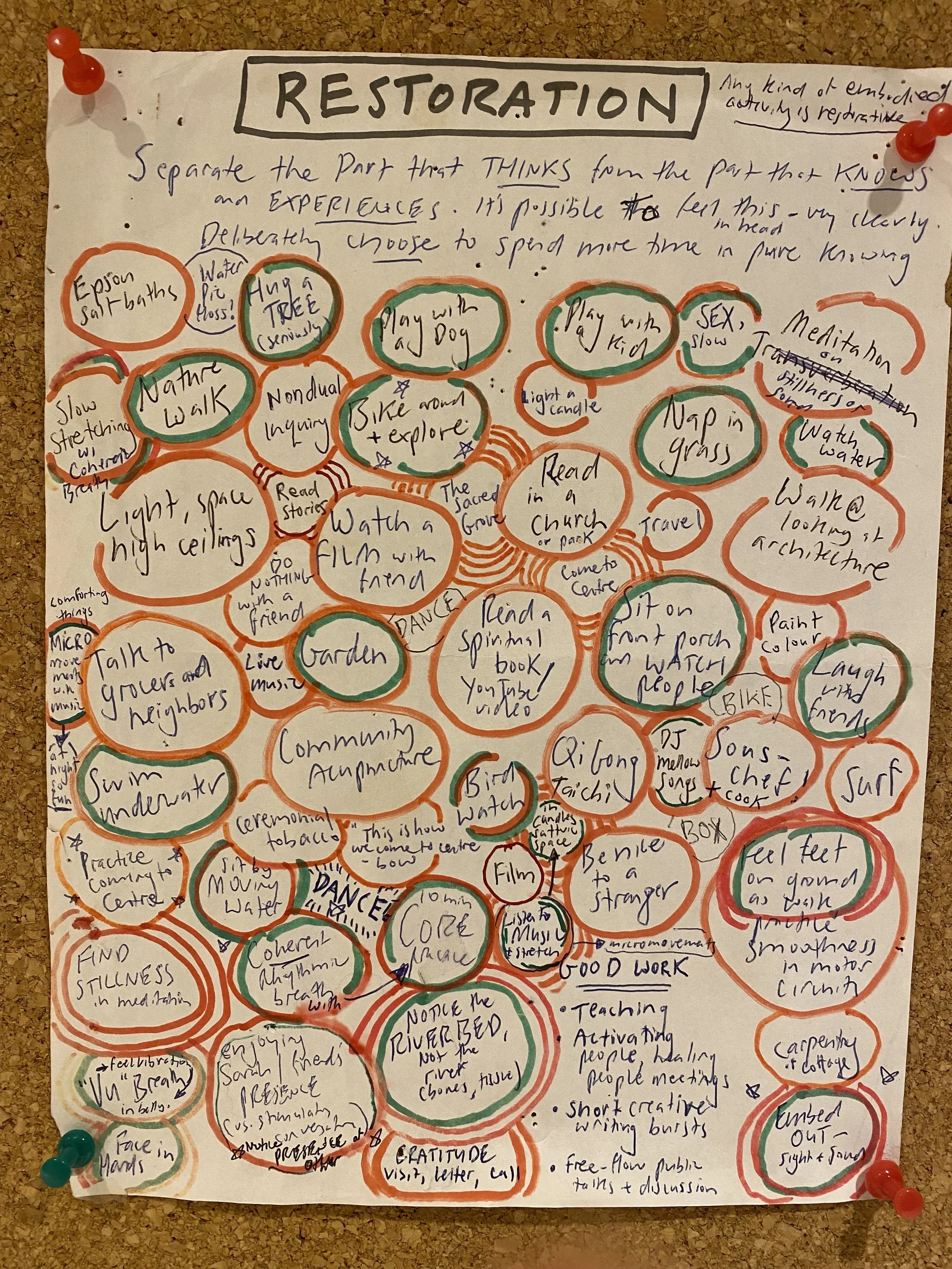
Photo Courtesy of Jeff Warren
5. Care about someone else
It’s a simple calculus: the more time we spend thinking about our problems, the more miserable we become. So take some time to deliberately think about someone else instead. And then stop thinking and act! Write a gratitude letter, bake a cake, share a practice. Care feels good to express, and it feels good to receive. Win-win.
💙 New to mindfulness? Explore Mindfulness for Beginners with Jeff Warren on Calm.

Mel Mah’s 5 quick strategies for improving your mental health
Mel Mah is a dancer, filmmaker, and yoga teacher from Ontario, Canada. She's the creator of Calm's Daily Move, a series of five to seven-minute mindful movement practices that have been viewed over a million times.
1. Close your eyes and take three slow, deep breaths
This allows you to come back to the present and back to your body. When you shut out all the noise and tune inward, you can slow the nervous system down and calm the mind. Breathing also connects you right back to the present.
2. Smile at a stranger. Maybe even throw them a compliment
We sometimes feel so isolated and lonely that we forget that people out there are waiting to connect! It starts with us. Spread some light even to people you don’t know and feel the difference it creates within you.
3. Move your body!
Get playful. Moving can mean dance, yoga, walking, working out… doesn’t matter. Listen to your intuition. The more you move your body, the more you get out of your head. This will help lower your stress level.
4. Slow down as you eat
It’s so easy to just shove food into your mouth and not think anything of it. But if you can make it a practice to only focus on your food when you eat, you’re doing more than just nourishing your body — you’re cultivating more present-moment joy.
5. Find one thing a day to be grateful for
Before you go to bed at night, think of one thing to be grateful for. It might even be helpful to write down your thoughts in a journal. The more gratitude you can cultivate on a daily basis, the more joyful and expansive you feel. Negative thoughts will always be there, but there will always be positive ones too. It’s all about what we’re focusing on. The choice is yours!
💙 Try Mindful Movement with Mel Mah on the Calm app.

Mental health tips FAQs
What are 5 ways to improve mental health?
There are many ways to improve mental health, but five simple evidence-based approaches are:
Physical movement
Consistent sleep
Social connection
Mindfulness
Meditation
Even short daily doses, a 10-minute walk, a five-minute breathing exercise, or a quick text to a friend, can make a real difference over time. You don’t need to do all five in one day to feel the benefits. Pick the ones that work best for your
What daily habits can improve mental health and well-being?
Improving your mental health is all about quality over quantity. Prioritizing the most important daily habits can make the biggest impact. Here are a few ways to get started:
Go to sleep and wake up at the same time each day
Move your body in some form
Eat without distractions
Connect with at least one other person
Take a few minutes for quiet reflection or meditation
What is the 3–3–3 rule in mental health?
The 3–3–3 rule is a grounding technique used to manage anxiety in the moment. To practice it, you pause and intentionally name three things you can see, three things you can hear, and three things you can feel or touch in your immediate environment.
The goal is to interrupt the spiral of anxious thoughts by redirecting your attention outward to your senses and the present moment. It's discreet and easy to do on the go.
What are simple self-care tips for mental health?
Self-care doesn't have to be elaborate — some of the most effective practices are simple. Take deep breaths before a stressful situation, step outside for fresh air, limit your phone time before bed, check in with a friend, and acknowledge something you did well that day.
How do I start improving my mental health if I feel overwhelmed?
Start with one thing. Not a full new routine, or total life overhaul. Pick the smallest possible action, like three deep breaths, a two-minute walk, or a text to someone you trust.
Overwhelm often shrinks when there's one concrete thing to do rather than a long list of should-dos.
What are some healthy coping skills?
Healthy coping skills tend to reduce stress without creating new problems. Some reliable ones include deep breathing or meditation, physical movement, journaling, talking to someone you trust, time in nature, creative activities like music or art, and structured routines.
The most important thing is that they work for you. What calms one person down might not calm another, so building your personal toolkit over time is important.
When should I seek professional help for mental health?
If your mental health is affecting your ability to work, maintain relationships, sleep, eat, or get through daily life, it's worth talking to a professional. You don't need to be in crisis to reach out. A therapist, counselor, or doctor can help you understand what's going on and explore your options, which might include therapy, medication, lifestyle support, or a combination. If you're not sure where to start, your primary care doctor is a good first call.
Calm your mind. Change your life.
Mental health is hard. Getting support doesn't have to be. The Calm app puts the tools to feel better in your back pocket, with personalized content to manage stress and anxiety, get better sleep, and feel more present in your life.

Images: Getty