
Clinically reviewed by Dr. Chris Mosunic, PhD, RD, MBA
Struggling to switch off at night? Yoga may be the answer. Discover the benefits of yoga for sleep and 8 simple ways to start your own bedtime practice.
The hours before bed can feel like a tug-of-war. You want to wind down, but your brain has other ideas. Maybe your shoulders are carrying the day’s tension, or your thoughts keep circling back to everything left undone.
Yoga offers a gentle way to ease that tension in your body and your mind. It combines slow, intentional movement with breath awareness and mindfulness, making the shift into sleep feel a little less like a battle.
Here's what you need to know about yoga for sleep, plus some beginner-friendly tips for building an evening practice that works for you.

What is yoga?
Yoga is a mind-body practice that combines physical postures (called asanas), controlled breathing, and focused awareness. It originated in ancient India and has evolved over thousands of years into many different styles and traditions, from vigorous and athletic to slow and deeply restorative.
For sleep, the styles that matter most are the calmer ones, like restorative yoga, yin yoga, and gentle hatha yoga. These use slow movements, long-held poses supported by props like pillows or blankets, and a steady focus on the breath.
What sets yoga apart from stretching is the intentional connection between movement and breath. That's what makes it a mindfulness practice as much as a physical one, and a big part of why it can shape how you feel by the time you lie down at night.
Can yoga help you sleep?
Yoga can help you sleep — with some realistic expectations. The evidence is fairly consistent that it can make a real difference, particularly as a supportive practice rather than a standalone solution.
But yoga isn't a cure for sleep disorders, and if you're dealing with chronic insomnia, it's worth speaking with a doctor about evidence-based treatments like cognitive behavioral therapy for insomnia (CBT-I).
Here's what the research suggests:
It may lower stress hormones: Cortisol, one of the body's main stress hormones, can make it hard to wind down when levels stay elevated into the evening. Some research suggests restorative yoga may help bring those levels down, easing you toward sleep.
It activates your rest-and-digest system: Slow, supported movement may help shift your nervous system from its alert "go" mode into a calmer, more restful state. Those effects remain after the session ends, giving your body time to settle before you get into bed.
It improves how sleep feels: Over 55% of yoga practitioners report improved sleep, and over 85% report reduced stress. Studies have also found meaningful improvements in sleep quality, anxiety, and fatigue with consistent practice.
It's a support, not a solution: People with chronic insomnia tend to report sleeping better with yoga, but it works best alongside other healthy sleep habits, not as a replacement for them.
Read more: Yoga for stress relief: 6 poses to help you find your calm

How to build a simple yoga-for-sleep routine: 8 beginner-friendly tips for better rest
You don't need to commit to a full class or clear an hour in your evening. A short, consistent practice done a few times a week is a perfectly solid place to start. Here's how to make it stick.
1. Choose the right type of yoga
Not all yoga is sleep-friendly. Hot yoga and vinyasa styles raise your heart rate in ways that aren't ideal right before bed, similar to running on a treadmill at 10pm. For unwinding, stick to restorative yoga, yin yoga, or gentle hatha yoga. These styles use slow, held poses, supported positions, and a focus on breathing rather than effort or intensity.
If you're browsing an app or searching for videos, look specifically for "bedtime yoga," "restorative yoga," or "yin yoga for sleep."
2. Find your ideal wind-down window
Doing your practice 30 to 90 minutes before bed tends to work better than rolling straight from your mat into bed. That window gives your nervous system time to settle into the calmer state yoga may produce, lining up nicely with the natural rise in melatonin that happens in the lead-up to sleep.
A good rule of thumb is to finish your practice, do your usual pre-sleep routine (brushing teeth, washing your face), then get into bed when you feel ready.
💙 For a full wind-down, pair yoga with Calm’s Peaceful Sleep meditation.
3. Create a space that invites relaxation
You don't need a studio or special equipment to start. Dim the lights if you can — bright overhead lighting signals to your brain that it's still daytime, so even just switching to a lamp makes a difference. Keep it quiet, or put on some soft music or a sleep meditation if silence feels a little empty.
For props, you don't need anything fancy. Pillows, blankets, and rolled towels all do the job:
A yoga mat helps with grip and cushioning, but a folded blanket or carpeted floor works just as well
A pillow under your knees can ease low-back tension
A rolled blanket under your ankles helps your legs relax more fully
A cushion under your chest in a forward fold creates a softer, more supportive shape
The goal is for your body to feel comfortable from the start, so you can sink into relaxation naturally.
💙 For a soothing soundtrack while you practice, try The Rainy Lofi Sessions on Calm.
4. Start with just 5–10 minutes
Rather than diving into an ambitious 45-minute practice that collapses by day three, start with one or two poses. Even 5–10 minutes a few nights a week is a strong foundation.
Building gradually over a few weeks is more sustainable than going all-in right away. Consistency matters more than duration.
If you only have a few minutes, focus on one grounding pose—like legs-up-the-wall or supported child’s pose—and pair it with a short breathing pattern.
💙 Start with five minutes of mindful movement with Calm’s Grounding Daily Move session.

5. Let your breath guide you
Breathing is one of the most powerful parts of yoga practice. The aim is to keep your attention on your breath, let thoughts drift away, and be present in the moment.
If your mind wanders (and it will), that’s completely normal. Just notice it and come back to your breath. This is essentially mindfulness meditation in motion, and the same gentle, non-judgmental approach applies.
Try: Ujjayi breath, sometimes called Ocean Breath. Inhale deeply through the nose, then exhale slowly through the nose while lightly constricting the back of the throat, creating a soft, wave-like sound. Once you find it, it's a naturally calming rhythm that anchors your attention and slows everything down.
💙 Struggling to connect to your breath? Try SOS Breath Work for a quick breathing practice.
6. Pick poses that help your body unwind
You don't need a long sequence to feel the difference. A handful of poses practiced regularly can be enough to shift your body into rest mode. Here are some good options to start with:
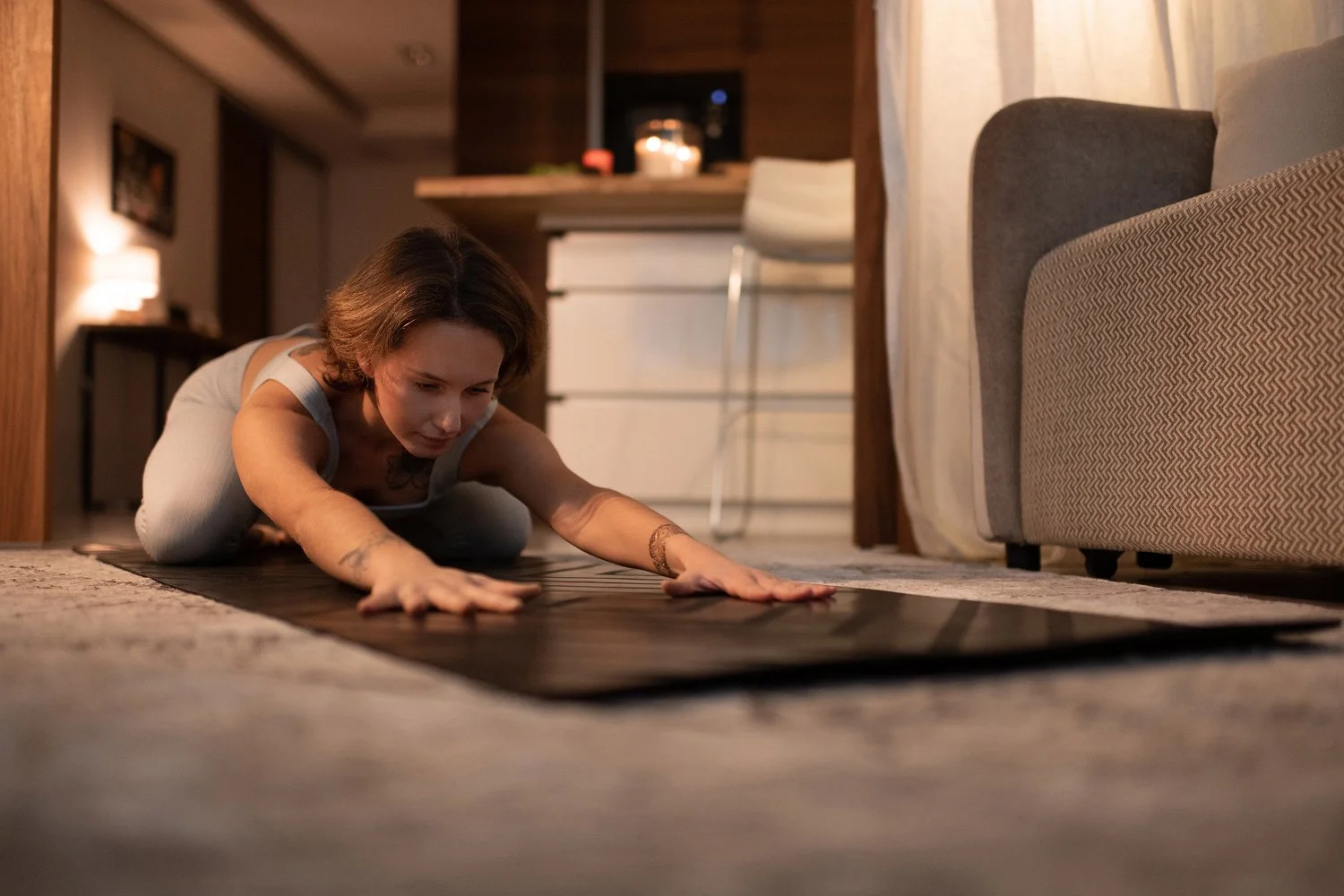
Child's pose (balasana): Kneel on the floor, bring your big toes together, and lower your torso between your knees, extending your arms forward or alongside your body. Hold for one to three minutes.
Legs up the wall (viparita karani): Lie on your back with your legs resting against a wall so your body makes an "L" shape, arms relaxed at your sides. It’s one of the most passive and immediately calming poses you can do.
Reclined butterfly (supta baddha konasana): Lie on your back, press the soles of your feet together, and let your knees fall open to the sides. Let your arms rest wherever feels comfortable, at your sides or above your head.
Supine spinal twist: Lying on your back, draw one knee to your chest and guide it gently across your body while keeping both shoulders on the floor. Hold for a minute on each side.
Corpse pose (savasana): Lie flat on your back, arms and legs straight, palms open and facing up, and let your ankles roll outward. The goal is complete relaxation from head to toe. This is often the final pose in any yoga sequence, and for good reason.
Read more: Bedtime yoga: these 5 poses will help you sleep better
7. Pair yoga with a consistent sleep schedule
Yoga works best as part of a broader approach to more restful sleep. The single most evidence-supported sleep behavior change is maintaining the same wake time every morning, including weekends, within about a 30-minute window. Yoga works well with this habit, rather than replacing it.
If you deal with sleep anxiety or a restless mind regularly, a short mindfulness meditation practice might be a helpful addition. Even five minutes of a body scan or breathing exercise before bed can deepen the physical relaxation your practice has already started.
💙 After your practice, let Matthew McConaughey's Sleep Story, Wonder, guide you the rest of the way.
8. Check in with your body before and after
Before you start, take a moment to notice where you're holding tension or feeling restless. That awareness can help you choose poses that actually suit how you feel tonight, rather than running through a sequence on autopilot.
After your routine, stay still for a few breaths and notice any small shifts, like a little more warmth, a sense of heaviness, or breathing that feels just slightly slower than before. You don't need a dramatic transformation. Small changes are worth noticing, and noticing them is part of what makes the habit stick.
💙 Tune into your body’s sensations with a short Body Scan on the Calm app.

Yoga for sleep FAQs
Should I do yoga before bed?
Gentle yoga before bed can be a helpful part of a wind-down routine. The key is choosing the right style — slow, restorative poses rather than vigorous flows. Evening sessions may help you release the stress and tension that accumulates throughout the day and prepare your body for more restful sleep.
Which type of yoga is best for sleeping?
Restorative yoga, yin yoga, and gentle hatha yoga are the most sleep-friendly styles. These approaches focus on slow, controlled movements, deep breathing, and long-held stretches that promote deeper relaxation. Avoid vigorous styles like vinyasa or hot yoga in the hours before bed.
Related read: 10 different types of yoga practices (and their benefits for mind and body)
Which yoga poses are best for sleep?
A few beginner-friendly poses are shown to consistently support relaxation:
Supported child’s pose helps release the back and shoulders.
Legs-up-the-wall encourages blood flow to settle and creates a grounding feeling.
Seated forward fold lengthens the spine and quiets the nervous system.
Supine twist softens the lower back and eases digestion.
Reclined bound-angle pose (with pillows under the knees) opens the hips gently.
Choose the poses your body naturally settles into. Comfort matters more than form.
Do I need to be flexible to do yoga for sleep?
You don’t need to be flexible to do yoga, especially when it comes to the restorative styles that work best for sleep.
Most sleep-focused poses are done lying down or sitting, and you can use pillows, folded blankets, or books as props to make any pose more comfortable. If a pose feels like a stretch too far, go only as far as feels good and use a prop to support you. Never force a pose.
How long should a beginner’s nighttime yoga session be?
If you’re a beginner to nighttime yoga, start with whatever feels manageable. Even 10 minutes and a couple of poses is a meaningful start. Work up to 20 or 30 minutes when it feels right, and you’ll likely notice the difference consistency makes. The goal is building a habit, rather than logging time.
Can yoga in the evening help with insomnia?
Yoga in the evening may help with mild to moderate sleep difficulties, particularly those driven by stress or tension. Research on yoga for chronic insomnia suggests improvements in how people experience their sleep, including reductions in anxiety, fatigue, and nighttime disturbances.
That said, yoga isn't a clinical treatment for insomnia. If you're dealing with persistent sleep problems, it's worth speaking to a doctor or therapist about CBT-I, which has the strongest evidence base.
Read more: Insomnia: what causes it, symptoms & how to prevent insomnia
Is restorative yoga good for sleep quality?
Restorative yoga is one of the most sleep-supportive styles. Its passive, supported poses help take physical effort out of the equation, making it easier for your nervous system to downshift.
The supported nature of restorative practice is part of what makes it so effective. Active effort can keep your body's alert state switched on even during gentle movement, and restorative yoga is designed to work around that.
Do I need a yoga mat to try yoga for sleep?
You don’t need a yoga mat to try yoga for sleep. A folded towel, a blanket, or a carpeted floor works fine, especially for the lying-down poses that make up most sleep-focused yoga sequences. A mat helps with grip if you're doing standing poses, but for bedtime yoga, it's very much optional. A few extra pillows will serve you better.
What if a yoga pose makes me feel restless instead of calm?
If a yoga pose makes you feel restless instead of calm, that’s useful information. Some poses simply don't suit everybody, and that's completely fine.
If a pose feels activating or uncomfortable, come out of it slowly and try a different one. Legs up the wall and corpse pose tend to be the most universally calming. If you're feeling restless throughout your practice, it's worth checking the style. Even a moderately energetic yoga video can be too stimulating before bed. When in doubt, go slower and more supported.
Calm your mind. Change your life.
Mental health is hard. Getting support doesn't have to be. The Calm app puts the tools to feel better in your back pocket, with personalized content to manage stress and anxiety, get better sleep, and feel more present in your life.

Images: Getty